Startup Fundraising
Best Startup Fundraising Platforms for 2026 (Compared & Ranked)

Best Startup Fundraising Platforms in 2026
Five startup fundraising platforms define capital formation in 2026 — Republic, Wefunder, Crowdcube, AngelList, and SOAR — each serving different stages, geographies, investor types, and ownership strategies.
The platform you choose shapes your investor base, compliance structure, and long-term cap table.
Key Takeaways
What is the best startup fundraising platform in 2026?
There is no single best platform.
Republic and Wefunder suit retail equity raises of $50K–$5M in the US
Crowdcube leads for UK and EU founders
AngelList targets accredited investors raising $500K–$10M+
SOAR offers a non-dilutive alternative for global early-stage founders looking to preserve equity and move fast
Which startup fundraising platform is right for early-stage founders?
Early-stage founders with limited traction typically have two realistic options:
Wefunder — community-driven raises starting around $50K
SOAR — non-dilutive capital formation globally without requiring a traditional equity campaign or accredited investor base
What should founders watch out for when choosing a fundraising platform?
Founders should evaluate three factors before committing:
Whether the platform is dilutive (equity) or non-dilutive
Whether their target investors are retail, accredited, or global
Whether their raise size matches the platform’s typical range
Choosing incorrectly can stall momentum and complicate the cap table.
What Is a Startup Fundraising Platform?
A startup fundraising platform is a regulated digital marketplace that connects founders with investors to raise capital through:
Equity crowdfunding
Syndicates
SPVs (special purpose vehicles)
Rolling funds
Digitally native financing models such as non-dilutive structures
These platforms manage:
Compliance
Investor onboarding
Campaign infrastructure
Capital distribution
Unlike approaching investors directly, these platforms provide structured intermediary infrastructure. They verify investors, manage regulatory filings, run campaign technology, and distribute funds.
In 2026, platforms vary significantly in:
Who they allow to invest
How much founders can raise
Whether founders must give up equity
How Startup Fundraising Platforms Work in 2026
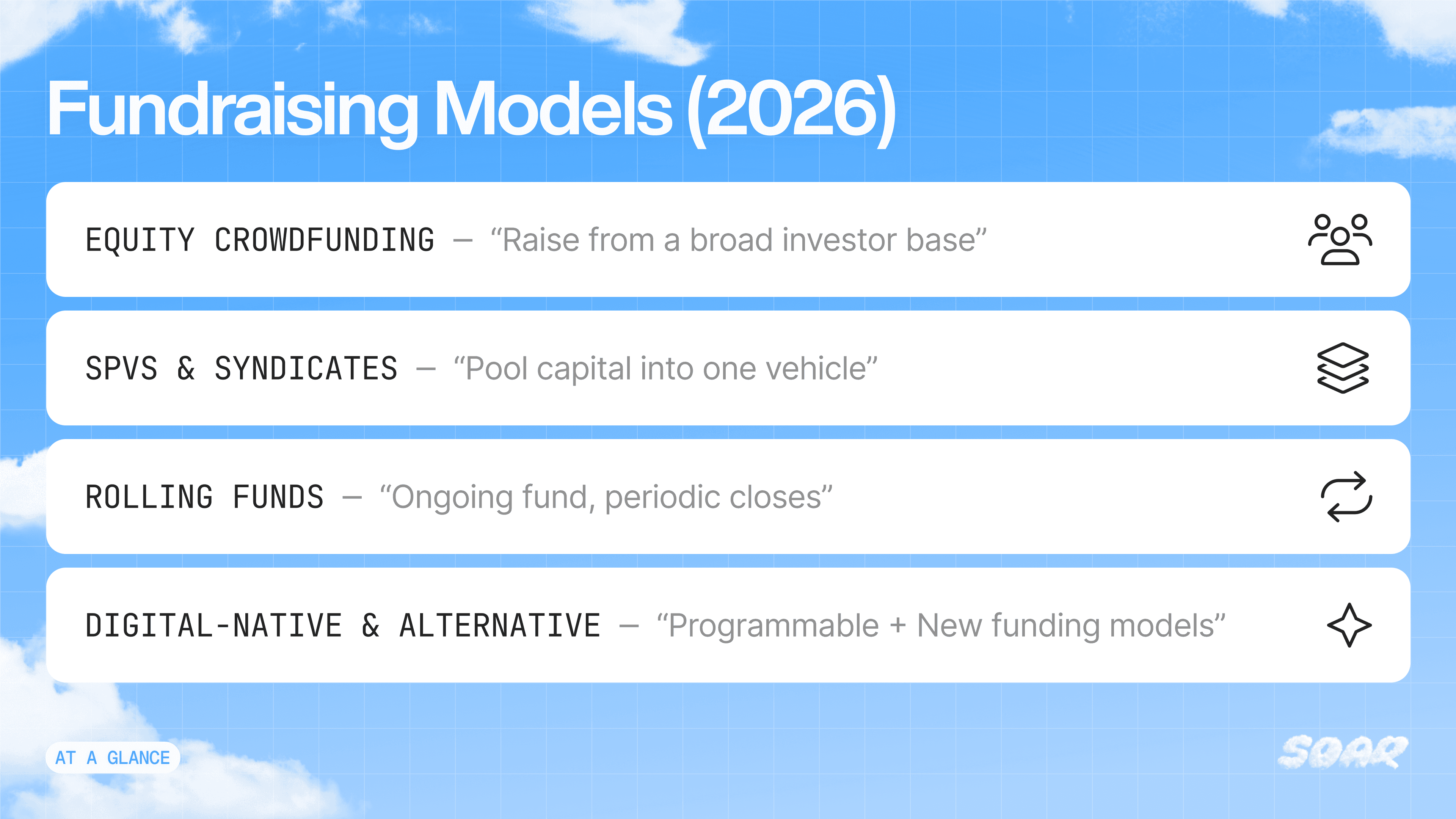
Startup fundraising platforms in 2026 operate across four primary models:
Equity crowdfunding (Republic, Wefunder, Crowdcube)
Syndicates and SPVs (AngelList)
Rolling funds
Digitally native non-dilutive structures (SOAR)
The biggest shift in 2026 is accessibility and globalization.
More founders outside the US are exploring platforms that allow broader investor participation, and retail investors increasingly want direct access to startup deals.
1. Equity Crowdfunding
Startups raise from a large pool of retail investors who purchase equity in small increments.
Platforms handle:
Regulatory compliance
Investor verification
Campaign infrastructure
Founders give up a percentage of their company in exchange for capital.
2. SPVs & Syndicates
Investors pool capital into a single investment vehicle (SPV) that invests in the startup.
Benefits:
Simplifies the cap table
One line item instead of many investors
This is the dominant model in accredited investor ecosystems like AngelList.
3. Rolling Funds
Rolling funds are continuous fundraising vehicles where investors subscribe periodically.
They are typically used by venture managers raising capital continuously, rather than through a single close.
4. Digital-Native & Alternative Models
Newer platforms experiment with digitally native capital structures designed for:
Faster fundraising
Global participation
Community alignment
One example is SOAR’s Digital Representation of Participation (DRP) model, enabling non-dilutive capital formation without traditional equity issuance.
Is non-dilutive fundraising through platforms like SOAR legally recognized?
Alternative capital structures such as SOAR's DRP mechanism are designed to reduce jurisdictional friction for global founders.
As with any financial structure, founders should review platform documentation with qualified legal counsel before proceeding. Platform terms vary by jurisdiction.
How to Choose the Best Startup Fundraising Platform
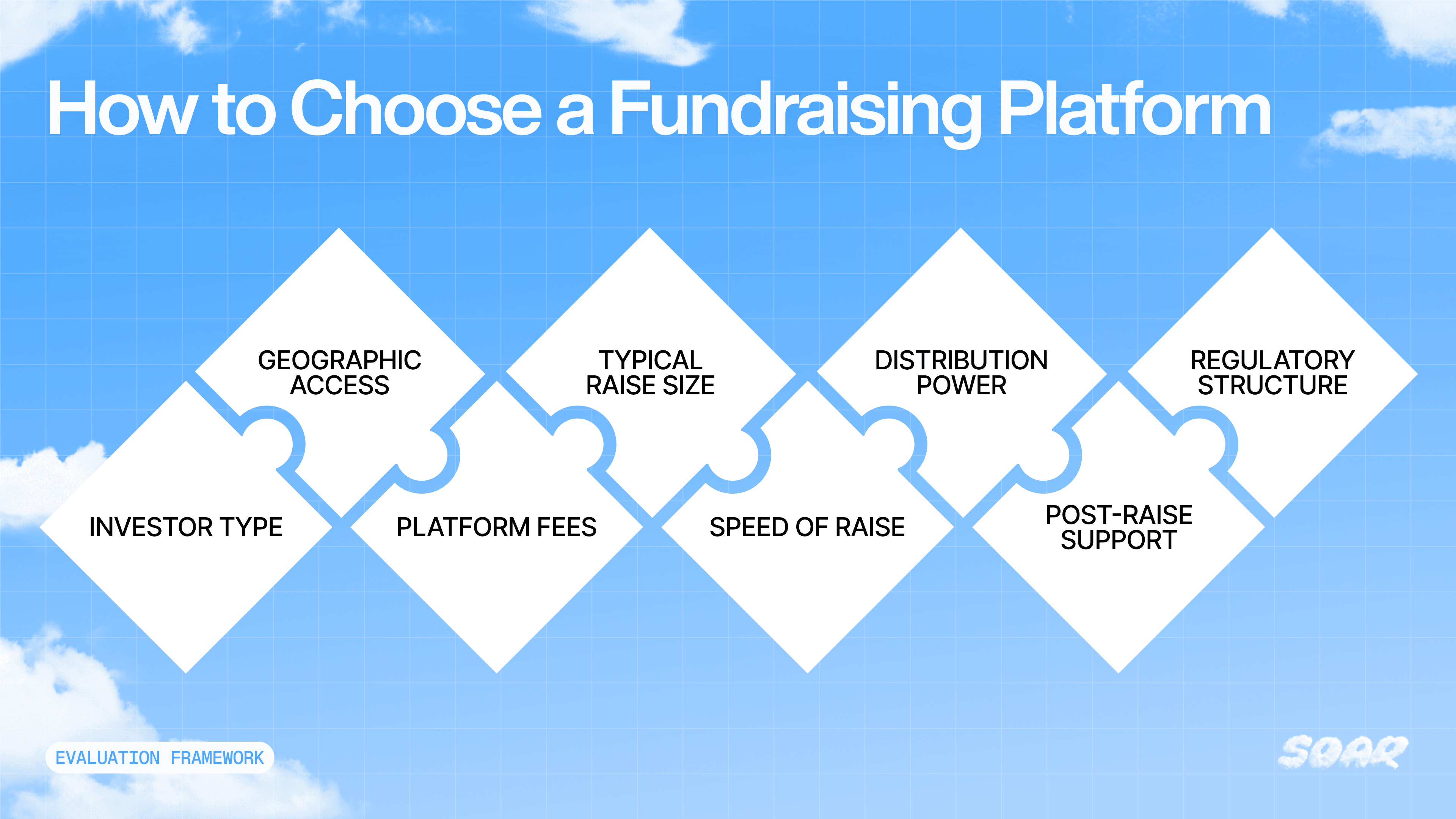
Choosing the best platform requires matching your raise profile to the platform’s actual structure.
Key evaluation criteria include:
Investor Type — retail, accredited, or institutional
Geographic Access — US-only, UK/EU, or global
Platform Fees — listing fees, success fees, legal costs
Typical Raise Size — does the platform match your target?
Speed of Raise — time from launch to close
Distribution Power — built-in investor audience
Post-Raise Infrastructure — investor tools and follow-on access
Regulatory Structure — complexity of compliance
Dilutive vs Non-Dilutive — whether equity must be issued
No platform leads in every category.
Best Startup Fundraising Platforms for 2026
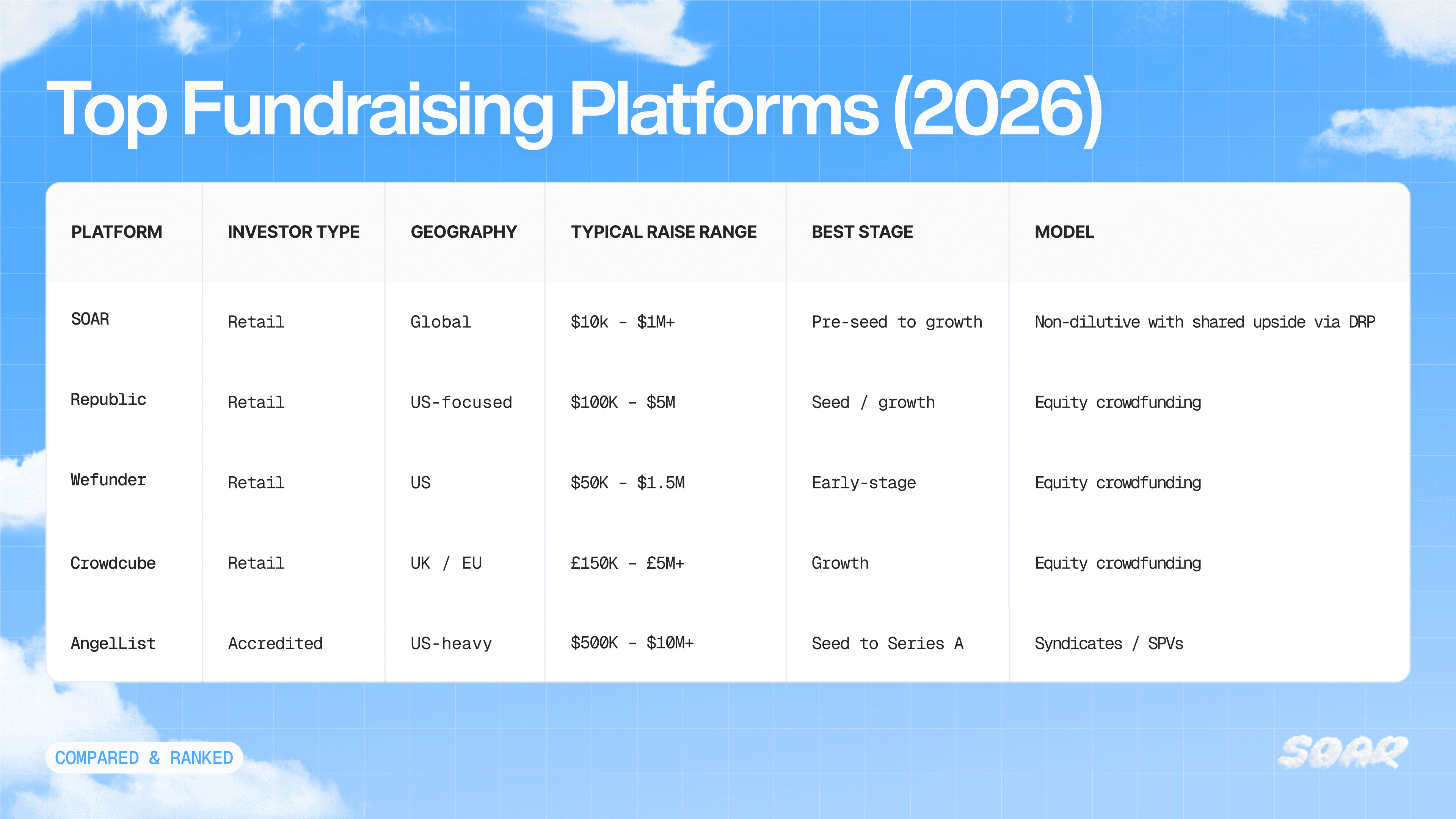
Below are the leading platforms founders are evaluating in 2026.
SOAR
Positioning
Non-dilutive capital with reinforceable shared upside
Best For
Early-stage startups
Digitally native companies
Consumer startups
Global founders
Typical Raise Range (2026)
$10K – $1M+ (structure dependent)
SOAR enables startups to raise through a non-dilutive Digital Representation of Participation (DRP) structure.
Founders access capital without issuing traditional equity, while capital allocators receive flexible exit mechanics and a liquid market layer.
Who can invest on SOAR?
SOAR enables retail-accessible global participation.
Everyday investors—not just accredited investors—can participate, allowing founders to access a broad capital base without US accreditation requirements.
Republic
Positioning
Large-scale equity crowdfunding platform
Best For
Consumer startups and brand-driven companies
Typical Raise Range
$100K – $5M
Wefunder
Positioning
Community-driven equity crowdfunding
Best For
Early-stage startups seeking grassroots support
Typical Raise Range
$50K – $1.5M
Crowdcube
Positioning
UK/EU equity crowdfunding leader
Best For
European startups with growth traction
Typical Raise Range
£150K – £5M+
AngelList
Positioning
Accredited investor syndicates and rolling funds
Best For
Venture-scale startups raising seed to Series A rounds
Typical Raise Range
$500K – $10M+
Which Startup Fundraising Platform Is Right for You?
The right platform depends on:
Geography
Investor type
Raise size
Equity strategy
Quick Decision Guide
Consumer brand with strong audience
→ Republic / Wefunder / SOAR
UK or EU startup
→ Crowdcube
Venture-scale startup targeting angels and VCs
→ AngelList
Early-stage company preserving equity
→ SOAR / Wefunder
Accredited-only raise above $1M
→ AngelList
Community validation raise under $1M
→ Wefunder / SOAR
Global access and a liquid market layer
→ SOAR
Emerging Trends in Startup Fundraising (2026)
Global Capital Pools – Geography is becoming less restrictive. Platforms enabling non-US founders to raise from global retail investors are growing in relevance.
Community Alignment – Customers increasingly overlap with investors. Platforms that allow a startup's own users to become backers are gaining strategic appeal.
Digital Structuring – Digitally native mechanisms such as non-dilutive DRP structures are entering the mainstream as founders look beyond traditional equity.
Regulatory Expansion – More jurisdictions are modernising crowdfunding rules, opening retail investor participation in previously restricted markets.
Faster Capital Formation – Digital-first processes are shortening raise timelines, with some structures enabling near-instant capital access.
Summary
Choosing the right fundraising platform in 2026 is a strategic decision.
Republic, Wefunder, Crowdcube, AngelList, and SOAR serve distinct founder profiles defined by:
Geography
Investor type
Raise size
Equity strategy
For founders prioritizing equity preservation and global access, SOAR offers a differentiated pathway through its non-dilutive DRP structure.
Financial Disclaimer
This article is for informational purposes only and does not constitute financial, legal, or investment advice.
Investing in startups involves significant risk, including the potential loss of capital.
Readers should conduct their own due diligence and consult qualified professionals before making decisions.

Frequently Asked Questions
The most asked questions about Startup Fundraising Platforms
What is the best startup fundraising platform in 2026?
Is equity crowdfunding better than AngelList syndicates?
How much do startup fundraising platforms charge?
Is SOAR's non-dilutive structure legally recognised?
How much do startup fundraising platforms charge?